

Gemma Slack
Haven’t got much time on your hands? Click here to read the key points.
In this Pinnacle Post interview, Gemma Slack - a trauma-informed Breathwork & Leadership Coach - reflects on an entrepreneurial career of community and pivots. From entering a community drug and alcohol facility at 18 to being a key founding figure of Momentum Waikato and Seed, to later discovering breathwork and now running her own trauma-informed leadership and breathwork business, Gemma shares incredibly candid insights into her journey. She discusses the realities of being a founder, the power of introspection, the importance of breathwork and offers practical, honest advice for young professionals.
Q: What did you want to be when you were growing up?
A: Growing up, I wanted to be a forensic scientist which was driven from my love of TV shows such as CSI, SVU and Law and Order. For a period of my life, I also wanted to be an archaeologist and dig up dinosaur bones. In general, I really enjoyed complex problem solving and the idea of studying, researching and observing things.
Q: That’s unique! You went to high school in Brisbane, tell me about your journey from Brisbane to ending up in Hamilton and studying at the University of Waikato (UOW).
A: I moved to New Zealand when I was 17, right after high school. It was a really challenging time as I was going through some mental health challenges and needed a lot of support. At 18, I ended up in CADS, a community drug and alcohol facility, and went through an outpatient support process four times a week for nearly two years. Looking back, that period shaped the way I understand leadership now. People are always carrying more than we can see, and the best leaders create environments where people can grow in their strengths, know they belong, and feel safe to tell the truth so that they can stay connected.
I had always wanted to study business, so once I got better, I applied and got into the UOW, and I’ve been in New Zealand ever since. Aotearoa gave me the ability to reconnect with myself, rebuild community, and heal. It’s been a gift of life, and I feel so lucky to call this place home.
People are always carrying more than we can see, and the best leaders create environments where people can grow in their strengths, know they belong, and feel safe to tell the truth so that they can stay connected.
Q: What specifically drew you to Hamilton?
A: My granddad and grandma lived here. My parents were in Brisbane trying to get me into a rehab facility over there, but they were all full. Granddad just called and said, "I’ll buy you a plane ticket. Come and stay with us for a bit." I thought, "Oh, yeah. Free trip," and I didn't go back. It was very special to develop those connections with my grandparents as an adult.
Q: Your first major role, which you started during university, was at Momentum. Tell me about that time.
A: I was doing a Self-Actualised Leadership paper at UOW where we talked about conscious capitalism and self-actualisation which is about making money while looking after the planet and people. Triple bottom line reporting was emerging at that time and Cheryl Reynolds was invited to give a guest lecture on this topic. Cheryl was setting up this new philanthropic foundation and was looking for volunteers. I ended up volunteering, and over summer I developed a policy and procedures manual and got deep into the research of philanthropy. I realised this was where I wanted to be because it made so much sense with my values as I was using business and strategy for community good. Cheryl then offered me a job, and I became the second employee, staying for four years. I helped build the foundation, going from the strategic plan to an operation with products and services for donors, and working on amazing research like Waikato Vital Signs.
Q: It’s unique that you combined that business skillset with helping people and charities so early.
A: I think everyone has a role to play. For some, building wealth first is important, and they can be philanthropic later. But for me, to be the best I could be, I needed it to be all in one - I wanted to be generous and live my values while also having an income and making a difference. I believed I could do it now; I didn't have to wait.
I think everyone has a role to play. For some, building wealth first is important, and they can be philanthropic later. But for me, to be the best I could be, I needed it to be all in one - I wanted to be generous and live my values while also having an income and making a difference.
Q: During your time at Momentum, you started Seed.
A: The Waikato Vital Signs project with Momentum gave me a lot of insight into the local youth space as well as going through leadership trainings such as the Rotary Youth Leadership Awards (RYLA). During that time, we were hearing from youth organisations that there wasn't much opportunity for young leaders to connect and grow. They didn't want to drink or play sport to meet people. Feeling that myself and seeing the research, I thought, "Let's do something about it". We started having coffee meetings and realised there was enough energy to hold an event. It turned into a big thing; we ran about 50 events, leadership programmes, and campaigns with local and central government, having close to three and a half thousand people come through.
During that time, we were hearing from youth organisations that there wasn't much opportunity for young leaders to connect and grow. They didn't want to drink or play sport to meet people. Feeling that myself and seeing the research, I thought, "Let's do something about it". We started having coffee meetings and realised there was enough energy to hold an event.
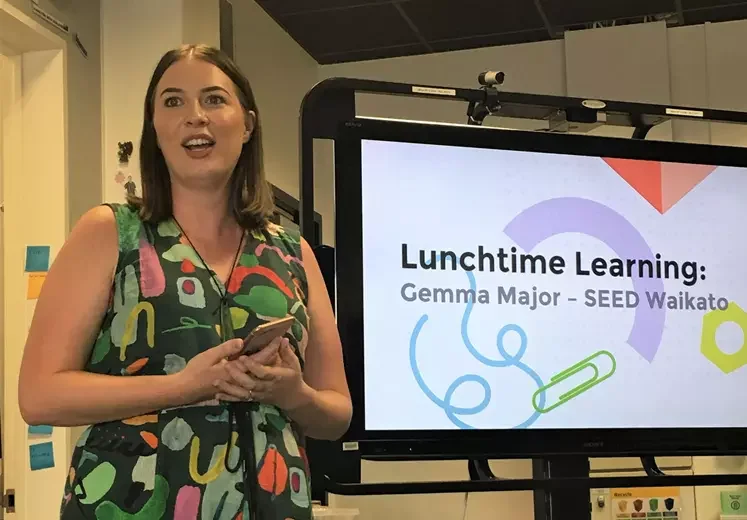
Gemma holding a lunchtime learning session during her time at Seed.
Q: Was it hard to leave Seed?
A: So hard. It's an amazing kaupapa, and I loved the people I worked with. Towards the end, I had developed a real passion for community-led development and systems change, and there were some inspiring young leaders we were supporting through an innovative project. It was a dream we'd shared as a sector for a long time, so stepping away when the multi-year grant came through was tough. I decided to see it as an opportunity to trust the relationships and leadership, the advocacy mahi, and the infrastructure we'd built. Like many founders, I had unknowingly wrapped a lot of my identity up in doing really impactful work. But once I became a mother, I realised what the organisation needed and what I could give were two different things. I’m a creative; I’m not a manager. I had to step back to honour my own journey, and to let the organisation transform into a new era.
Like many founders, I had unknowingly wrapped a lot of my identity up in doing really impactful work. But once I became a mother, I realised what the organisation needed and what I could give were two different things. I’m a creative; I’m not a manager.
Q: Shortly after stepping away, you got into breathwork. That’s quite a pivot.
A: I took a couple of months off to rest. I was also going through a divorce, and I found breathwork when I was trying to figure out a way to really trust myself through that process. Becoming a solo mum with little family support was hard, and I needed something that would help reduce anxiety, manage that overwhelming feeling, and bring calm to the chaos. It was incredible and it was a life-changing tool to let go of stress and tension, be in my body, and trust the process of change. I loved it so much I retrained in it.
I was also going through a divorce, and I found breathwork when I was trying to figure out a way to really trust myself through that process. Becoming a solo mum with little family support was hard, and I needed something that would help reduce anxiety, manage that overwhelming feeling, and bring calm to the chaos.
Q: How did you decide to turn it into a business rather than just keep it as a personal coping mechanism?
A: For a long time, I had tried to strategise or think my way through life, but I reached a point where I needed to let go and listen to my heart more. I felt really inspired by the idea of supporting other people with this work and I just thought, "Why not?" I’ve been in startups for so long, and I realised if you adopt that entrepreneurial mindset, you can grow something. I saw in New Zealand that breathwork wasn’t very accessible; it was either "super woo woo" or "really clinical". I saw an opportunity to make it accessible. As a solo mum, I also needed a flexible working option.
For a long time, I had tried to strategise or think my way through life, but I reached a point where I needed to let go and listen to my heart more.
I saw in New Zealand that breathwork wasn’t very accessible; it was either "super woo woo" or "really clinical". I saw an opportunity to make it accessible. As a solo mum, I also needed a flexible working option.
Q: You are very in touch with your values. When and how did you discover your values?
A: I discovered them through impactful experiences such as going through a divorce, becoming a mother, and having to make tough decisions in my leadership roles. I had to ask myself, “can I be ok with the consequences of making decisions through these lenses?” The lenses are my values.
I had to ask myself, “can I be ok with the consequences of making decisions through these lenses?” The lenses are my values.
Q: How did you get the business running and convince people that breathwork was beneficial?
A: Breathwork can be confronting, and I realised early on that I wasn't going to do any traditional convincing or selling. I decided to just share and document the process, trusting that the people it’s for will get it. In the early days, I shared it for free and listened to how people talked about their experience. This helped me communicate my science-based training using language that resonated. Breathwork really resonated with people who were feeling stuck and disconnected and had tried traditional tools such as talk therapy, mindset coaching, or self-help books, but needed a somatic tool to make the change. I’ve now shared breathwork with more than a thousand people, and every single experience is unique.
I’ve now shared breathwork with more than a thousand people, and every single experience is unique.
Gemma’s leadership coaching & breathwork business: https://www.gemmarose.nz/
Q: I know people who have tried it and said it can be quite intense, but the feeling once finished is amazing.
A: We suppress so much emotional experience and memories because we aren't taught how to be with our emotions. Stressful and traumatic things can get stuck and stored in the body and breathwork gives you enough space to process whatever has been stuck and what has disconnected you from yourself, leading to clarity, confidence, and freedom. In my workshops, I’ll have someone releasing rage all the way to experiencing bliss in fits of laughter. Even a short, five-minute breath practice can help you feel grounded and connected in your parasympathetic state, which helps you stay creative in the face of stress, keeps you connected to other people, and supports better decision-making.
We suppress so much emotional experience and memories because we aren't taught how to be with our emotions. Stressful and traumatic things can get stuck and stored in the body and breathwork gives you enough space to process whatever has been stuck and what has disconnected you from yourself, leading to clarity, confidence, and freedom.
Q: You work with a wide range of people, from social workers to politicians to musicians to business executives. You said you got to know these people in a unique way. Is there anything that specifically sets high-performing leaders apart?
A: They truly acknowledge their own humanity, and give themselves the support they need to be resilient in the face of the unknown. They take on a lot of responsibility and carry it well. They hold a vision over the circumstance and inspire people into that vision. They uplift people and draw out their strengths. They are deeply connected, and use their brilliant, intuitive nature as a superpower in their leadership. They execute with excellence and are committed to learning the necessary technical, mindset, or nervous system skills. They know when to ask for help, actively seek feedback, put accountability structures in place, and never shy away from themselves or the truth…it always reveals where their next level of growth is.
They know when to ask for help, actively seek feedback, put accountability structures in place, and never shy away from themselves or the truth…it always reveals where their next level of growth is.
Q: Looking back on your career, which has had a constant theme of helping people across different avenues, what are the main things that enabled you to succeed or grow?
A: For sure a deep gratitude for all the people who have helped me, and having that lived experience with mental health, I’ve just found a lot of purpose in service. Probably being a bit naïve to be fair about how much work some big goals take, but I guess I’ve had a relentless commitment to figuring it out, no matter what. There’s an orientation towards growth and learning and always asking, "What do I get to learn right now?" I have an insatiable thirst for knowledge and a wild curiosity that keeps fuelling me. I am willing to hold things lightly and willing to be wrong about things. That willingness to be wrong allows me to test things from many angles, leading to precision when it comes time for execution. My indigenous and Maaori friends and mentors, who have shared wisdom, knowledge, and puuraakau (story) have taught me the beauty, resilience, strength and power of authentic, reciprocal relationships.
Q: That's a common theme: life is all about people, relationships and curiosity.
A: I used to have an Albert Einstein quote on my desk at Momentum that said "I have no special talents. I'm just passionately curious". The work I’m doing now to understand the nervous system, has helped me realise that success is also dependent on your capacity. The creators and entrepreneurs that go the distance see that their capacity is a success factor and they take care of their wellbeing. If you don't expand your capacity, the resilience, creativity, and problem solving will dry out, and you will burn out.
The creators and entrepreneurs that go the distance see that their capacity is a success factor and they take care of their wellbeing. If you don't expand your capacity, the resilience, creativity, and problem solving will dry out, and you will burn out.
Q: Where did your entrepreneurial spirit come from?
A: My dad. I was 12 when I had my first business and he taught my sister and I how to set up a kit to wash cars in the neighbourhood. We ended up saving enough money to buy a plane ticket from Brisbane to New Zealand to visit family. Dad always taught us how to add value, create value, find opportunity, and, most importantly, how to be resourceful and make the most of what you have right now. In a startup, you need to be incredibly resourceful.
In a startup, you need to be incredibly resourceful.
Q: What advice would you give a young professional reading this who want to start a business?
A: Check the place inside of you that wants to build it. Is it coming from your values and a deep connection to your community, or is it to prove something so that if you succeed, you’ll be worthy, or valuable, or enough? Or is it from an honest place to serve and connect? Ask yourself, "If you had nothing to prove, do you still want to do it?" and "If you knew you were enough, do you still want to do it?" You create differently when you notice the place you are creating from.
Ask yourself, "If you had nothing to prove, do you still want to do it?" and "If you knew you were enough, do you still want to do it?" You create differently when you notice the place you are creating from.
Q: What advice would you give to someone who is unhappy, or wants a change but is scared to leave a secure wage?
A: What if it goes from good to great? You must let go of a bit of security and take a bet on yourself. It's not about trusting that it will go the way you think but trusting that you are the type of person that can figure it out. When you have that mindset, you can start with one idea and pivot through 20 more. You can't get to the end of your life with unlived dreams - that’s deep regret. If you know you are the type of person who is resourceful and can tolerate complexity, uncertainty, and the unknown, just go. This isn’t for everyone and you either have that risk profile or you don’t.
You can't get to the end of your life with unlived dreams - that’s deep regret.
Q: Being involved in multiple high-pressure startups with a young family - how do you deal with stress and manage life outside of work apart from breathwork obviously?
A: I have good boundaries. I used to let work be my entire personality, but it’s not allowed to be now. You need a vision for your life outside of work. I don't tie my identity or worth to what’s happening in the business. I prioritise how I feel about my life at home. I rely on journaling and a lot of time in nature. I have a day every week I call my burnout insurance - a no-demands Thursday where I just do whatever my body-mind system needs, such as a hike or yoga. Having that flexibility to listen to my body once a week supports me to stay well.
I have good boundaries. I used to let work be my entire personality, but it’s not allowed to be now. You need a vision for your life outside of work. I don't tie my identity or worth to what’s happening in the business. I prioritise how I feel about my life at home.
Q: What does Gemma stand for?
A: I think that when you feel safe to be your authentic self, when you follow your passions, when you’re connected to your community, when you believe in the potential to contribute something meaningful to the world, and just show up to do what you can each day, really amazing and good things happen. If you’re willing to do the work to feel safe trusting yourself fully, you can live a life that you really love on your own terms.
If you’re willing to do the work to feel safe trusting yourself fully, you can live a life that you really love on your own terms.
Q: Tell me about your career highlights and lowlights.
A: A highlight must be organising an event with my team at Seed where close to 100 people across the youth sector came together for a wellbeing retreat. It was amazing to connect young leaders and see how we could work together as a sector to influence system-level change, such as policy with local or central government. Building some epic relationships and partnerships to receive a $500k, multi-year grant to support an innovative pilot with Seed Waikato was a peak for sure. And receiving a Civic Award from Hamilton City Council for services to youth and community was a real honour. Supporting the founding Committee of Momentum’s Waikato Women’s Fund to get established in the early days was very inspiring. Another highlight was helping to establish the youth advisory group (now Youth in Philanthropy) when I was on the board of Philanthropy New Zealand (PNZ). They’re an amazing bunch of humans. I still remember the day the PNZ Board unanimously voted for a policy change that meant moving forward, at least one young person would be represented on the board, even if they weren’t voted on. It meant a lot to us as young people working in the sector to have that representation, and working to get that across the line with everyone was special to me.
The biggest lowlight for me was looking back and seeing how hard I pushed myself at times, working non-stop 80-hour weeks, and the harm that did not only to my health, but also the ripple-on effect that had, no doubt, on my team, and my closest relationships. And I did burn out pretty bad. The thing is, it's been a catalyst for growth. It's uncomfortable to notice how your own perfectionism takes away growth opportunities for others to make mistakes and develop their own leadership. But that's a good discomfort to sit with, right? It inspires repair, and to reimagine the conditions for everyone to grow, together. We can sit with those uncomfortable things to notice the better choices we can make, and that shapes our next evolution of leadership.
The biggest lowlight for me was looking back and seeing how hard I pushed myself at times, working non-stop 80-hour weeks, and the harm that did not only to my health, but also the ripple-on effect that had, no doubt, on my team, and my closest relationships. And I did burn out pretty bad.
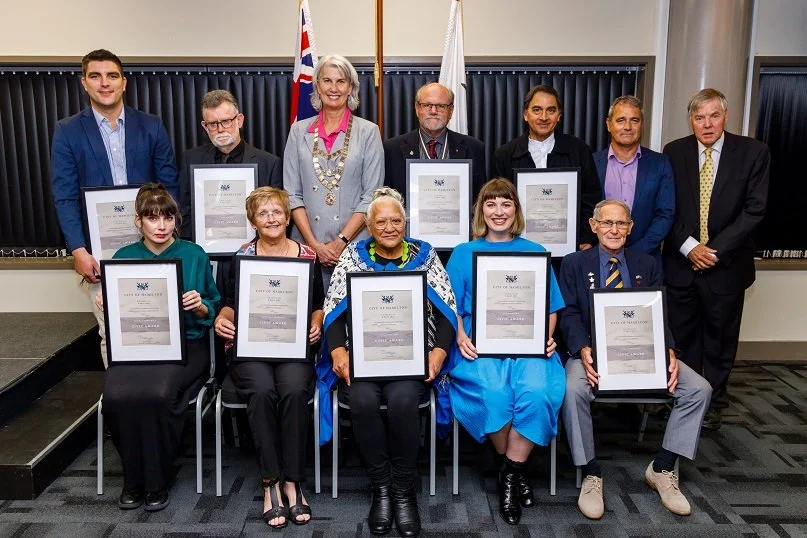
Gemma receiving the Hamilton City Council Civic Award for her services to youth and community.
Q: What advice would you give to a young person who wants to get into governance?
A: If you get elected or appointed, own the unique value, perspective, and experience you have and leave the imposter syndrome somewhere else. You are at the table for a reason - not because you have 50 years of experience, but for a different reason. Don’t compare. Be willing to ask for a mentor in the boardroom. Arrange a 30-minute call before a board meeting to soundboard your thoughts and questions. Be willing to get feedback, and be willing to give back to your mentor, too.
If you get elected or appointed, own the unique value, perspective, and experience you have and leave the imposter syndrome somewhere else. You are at the table for a reason - not because you have 50 years of experience, but for a different reason. Don’t compare.
Q: What’s next for Gemma?
A: I’m really curious about how inner work and somatic therapy can become more accessible to everyday people. My ultimate dream is to be part of making it possible for someone to visit their GP and be referred to free or subsidised breathwork or somatic therapy sessions. Talk therapy is critical, and for many people it’s life-changing, but stress and trauma can also live in the body. Sometimes we can’t think our way through what we’re carrying; we need safe ways to feel, process and release it. Breathwork and other somatic therapies can be powerful tools for helping people reconnect with their bodies, regulate their nervous systems, and move through what they’ve been holding.
Q: You did an OE (overseas experience), studying entrepreneurship in the Netherlands. What advice would you give to young professionals considering an OE?
A: Go for it. If you are still studying, see if you can get a scholarship. You’ll be drawn to go somewhere for a reason, and you’ll meet people or experience a culture, art, or history that might be important for your next career step. Just do it; it’s well worth it. New Zealand is a small place so getting out of your bubble is good because you get to see what you might want to bring back.
Q: For young professionals who are beginning to think about their financial futures, do you have any advice or wisdom to offer them?
A: Read the Barefoot Investor. It was a really significant experience after university to have a decent income coming in, and that system helped me manage finances (like 10% here, 20% there). Practice discipline from the start and get your money working for you. Uncle Albert says compounding interest is the eighth wonder of the world. Get a shares account or Invest Now account, put money into an index fund, and adopt a "set and forget" approach. Implement processes that will make it hard for you to get the money out.
Practice discipline from the start and get your money working for you. Uncle Albert says compounding interest is the eighth wonder of the world.
Q: What advice would you give your younger self?
A: Take a breath, take a pause. Be more of yourself, and don’t hide it away; being yourself is your superpower. Just because you don’t see anyone being how you want to be doesn’t mean you shouldn’t be it.
Q: Finally, if neither time nor resources were a constraint, what ultimate goal or dream would you pursue?
A: The first thing that comes to mind is contributing meaningfully to healing and restoration in Aotearoa, including the role Tauiwi can play in supporting equity, honouring Te Tiriti, and uplifting intergenerational wellbeing. I'd be making memories with my family travelling the world and I'd complete a PHD, write books, and fundraise for good causes in my community.
About Gemma Rose Trauma-Informed Coach and Breathwork Practitioner
Gemma Rose is a trauma-informed Leadership Coach and Breathwork Practitioner working with high-capacity, deeply feeling people who are exceptional at carrying everything and are ready to stop. Through offerings like Breathwork, her self-paced "No New Things" programme, and "Encounter" for creatives and entrepreneurs bringing ideas to life, she helps clients trade overthinking and over-giving for genuine self-trust. A University of Waikato graduate with nearly a decade as a founder and strategic advisor in the philanthropic sector, Gemma brings that same depth and strategy to the inner work.
Visit the website here: https://www.gemmarose.nz/
About Philanthropy New Zealand
Philanthropy New Zealand is the peak body for grantmaking and philanthropic giving across Aotearoa, bringing together funders and donors to strengthen a thriving, future-focused giving sector. It supports members through funder networks, research and insights, events, and learning opportunities all aimed at advocating for effective, enabling giving frameworks. The goal: a New Zealand where communities have what they need to thrive for generations to come.
Visit the website here: https://www.philanthropy.org.nz/
About Seed
Seed Waikato is a Hamilton-based organisation backing young people to lead systemic change for a more equitable Waikato, working across initiatives like Seeds for Change, Ngaa Kaakano, and Te Aka Matua to grow community-driven changemakers. Based out of Hive 11, their coworking and events space in Frankton, they connect rangatahi with the tools, networks, and opportunities to turn their ideas into action. It's a movement built on the whakataukī "Poipoia te kaakano kia puaawai" - nurture the seed and it will blossom.
Visit the website here: https://www.seedwaikato.nz/
About Rotary Youth Leadership Award (RYLA)
RYLA is Rotary's intensive leadership programme, run locally by Rotary clubs and districts for ages 14-30, ranging from one-day seminars to weeklong camps. Participants build communication and problem-solving skills, learn from community leaders and peer mentors, and turn motivation into action all while forming lasting connections. Entry is by nomination through a local Rotary club, making it a standout pathway for young professionals looking to sharpen their leadership edge.
Visit the website here: https://www.rotary.org/en/our-programs/rotary-youth-leadership-awards
About Momentum
Momentum Waikato is the region's community foundation, connecting generous donors with proven charities and causes from Pokeno to Te Kuiti and Tokoroa. Through a "smart giving" model, donations grow into perpetual funds that keep delivering for Waikato communities whether through a bequest, a contribution to a fund like the Waikato Women's Fund, or a named fund of your own. The result: a lasting legacy for a better Waikato, for everyone.
Visit the website here: https://momentumwaikato.nz/
About University of Waikato
The University of Waikato is a leading tertiary institution in Aotearoa New Zealand, renowned for innovative research, diverse academic programmes, and a vibrant campus culture. With world-class teaching and strong industry connections, Waikato empowers future-ready graduates to make real impact across New Zealand and beyond.
Visit the website here: https://www.waikato.ac.nz/
