

Haven’t got much time on your hands? Click here to read the key points.
In this Pinnacle Post interview, Steve Holloway - co-host of Between Two Beers podcast and co-founder of Reflections - reflects on a remarkable career. From chasing the professional football dream to spending three years as a professional poker player before becoming a top journalist at the NZ Herald and later creating New Zealand’s top podcast, Between Two Beers, Steve shares candid insights into his journey. He discusses the unique transferrable skills from poker, the importance of surrounding yourself with good people and offers valuable advice for people with side hustles and for young professionals in general.
Q: What did you want to be when you were growing up?
A: My dream was to be a professional footballer, and it was virtually all I focused on; football first, school second. I was quite talented for my age and played for a lot of age-group representative teams. However, I always lacked top-end speed, and being a striker, that lack of pace was always going to be a hurdle. I’ll be the first to admit that I was a bit of a "slug", but I was clever and I knew where to be and how to score.
I still thought there was a chance of playing professionally, though, so I went to Monmouth University in America on a football scholarship for four years.
Q: Was the goal always to head to the US (United States) for football, and how did you navigate that process?
A: Back then, the US scholarship avenue was still quite new for New Zealanders; only a handful of people such as Ryan Nelson, Simon Elliott and Tony Lochhead had done it. There were no digital links or easy ways to share highlights, so my dad brought a huge camcorder to a Napier under-19 tournament to film my games. He cut out clips and put them on a CD to send over to Monmouth University. I was lucky because a fellow Hamilton player, Scott Granville, was already there and could vouch for the level I was playing at. After passing the SAT tests to prove I was academically viable, the school took a punt on me. I started on a half scholarship and eventually earned a full scholarship by the end of my first year having played well.
Back then, the US scholarship avenue was still quite new for New Zealanders; only a handful of people such as Ryan Nelson, Simon Elliott and Tony Lochhead had done it. There were no digital links or easy ways to share highlights, so my dad brought a huge camcorder to a Napier under-19 tournament to film my games.
Q: You clearly made an impact there, eventually being named an NCAA (National Collegiate Athletic Association) All-American. How close did that get you to the professional leagues?
A: My senior year was huge; I was one of the top scorers in the country and made the NCAA All-American third team. I’d hoped that would get me into the MLS (Major League Soccer) combine where the professional coaches do their scouting, but I didn't make the cut. At the time, there were strict limits on international players, and teams often saved those spots for established European superstars rather than college kids. I tell myself that’s why I didn't make it, but I probably just wasn't quite good enough to make that final step up. I was a very good National League player, but I lacked that top-end speed required for the pros.
Q: Looking back, do you still think that the US is a viable path for young athletes today?
A: I recommend that path to anyone. The infrastructure in the US is just unbelievable. The best-case scenario is you leap into a professional team, but the worst-case scenario is that you bounce out with a degree. In my case, I spent four years completing a communications degree, majoring in journalism and minoring in public relations. It gave me a massive frame of reference before I eventually settled back down. Even if the football dream doesn't stick, you’ve set yourself up with a foundational skill set for the next chapter of your life.
I recommend that path to anyone. The infrastructure in the US is just unbelievable. The best-case scenario is you leap into a professional team, but the worst-case scenario is that you bounce out with a degree.
Q: How did you navigate that transition from US Football back to New Zealand?
A: My dad was a sports journalist at the Waikato Times for over 20 years, so I had communications in my blood, but I’d been quite relaxed about school. I chose a communications degree in America because it’s generally what people do when they don’t know what they want to do.
When the MLS football dream didn't work out, my dad got me a foot in the door at the Waikato Times for about six months. After my time at the Waikato Times, I trialled at some English clubs such as Barnet, Dagenham & Redbridge and Kidderminster before heading back home and getting a job as a media officer for the Oceania Football Confederation. Seamus, my podcast co-host, also worked there. But I still wasn't ready to give up on football, so I went back to Australia to try one more time, but the deal I was promised didn't materialise, and I ended up back in Hamilton living with my parents. This was in 2008, right in the middle of the Global Financial Crisis, and there were no jobs.
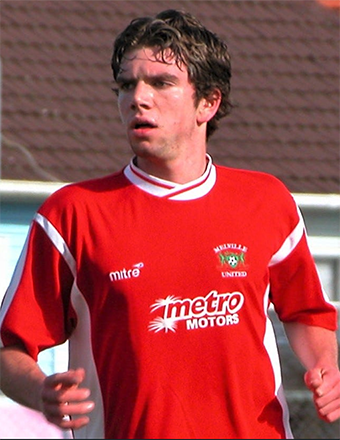
Steve playing football for Melville United in his earlier days.
Q: You’re 22 or 23, living at home during a global recession. How did professional poker become the solution?
A: I’d played a lot of poker in the US and realised that it’s a game of skill rather than luck. I told my parents that I was going to try being a professional poker player for a month. I made $4,000 in that first month on dial-up internet, so I decided to back myself. I ended up doing it for three years.
I moved to Mount Maunganui and eventually Queenstown and was playing heads-up tournaments with $50 or $100 buy-ins. During that time, I got taken under the wing of some high-stakes players who became my "backers". They’d cover 100% of my buy-ins which could be $3,000 to $4,000 per day and we’d split the profit 50/50. It removed the risk for me. Looking back, poker is just problem-solving. You use the information you have to make the best decisions and learn from the experience. It also gave me a very high-risk tolerance, which has been massive for my business career.
Looking back, poker is just problem-solving. You use the information you have to make the best decisions and learn from the experience. It also gave me a very high-risk tolerance, which has been massive for my business career.
Q: For many, the idea of professional poker sounds like a total gamble. What do we need to know about Steve Holloway that makes sense of why you chose that path over something more traditional?
A: I have a very high-risk tolerance, and I’ll be the first to admit that I love a gamble. At that stage in my life, I had no responsibilities, a deep desire for a thrill, and I was looking for the fastest avenue to get out of my parents' house. I also really enjoy doing things differently. There were a lot of doubters who thought the idea of playing poker for a living was a joke and that I’d eventually go broke, and I liked the thrill of trying to prove them wrong. I saw a path to potentially make a lot of money after seeing others succeed, and because I was a quick learner and found the game fun, everything just lined up for me.
I have a very high-risk tolerance, and I’ll be the first to admit that I love a gamble. At that stage in my life, I had no responsibilities, a deep desire for a thrill, and I was looking for the fastest avenue to get out of my parents' house.
Q: Why did you eventually fold that career and move back into journalism?
A: My friends all moved to Las Vegas, but I was with my then girlfriend and now wife, Bon, and we didn't want to go. I tried doing poker solo in Auckland for eight months, but it was lonely and unsustainable. I wanted a future, a home and security, and you don't get that playing poker.
I applied for one job: Assistant Digital Sports Editor at the New Zealand Herald. The digital team comprised of one person back then in 2012. I had to explain my three years of poker on my CV, and luckily, they saw the problem-solving aspect of it and loved it. I stayed there for 12 years, working weekends for the first six years and doing everything from live blogs to writing headlines.
Q: You’ve seen a lot of change in that industry. What’s your take on the state of journalism today?
A: It’s a tough industry now. When I started, it was desirable, but by the time I left, there were redundancies every other year. The quality of sports journalism in New Zealand has suffered because the best people aren't always pursuing it as a career choice anymore. However, the skills are incredibly transferable. Being able to write, interview, and identify good information is a foundational skill. Even with AI (artificial intelligence), good writing stands out. AI can create "slop," but if you know how to structure thinking and research, you’ll always have value. Trust is becoming the most valuable currency in a world where it’s hard to know what’s real.
Being able to write, interview, and identify good information is a foundational skill. Even with AI (artificial intelligence), good writing stands out. AI can create "slop," but if you know how to structure thinking and research, you’ll always have value. Trust is becoming the most valuable currency in a world where it’s hard to know what’s real.
Q: During your time at the Herald, you started the Between Two Beers podcast. The shift from journalist to podcaster seems quite natural. Was it a calculated move to leave the Herald, or was the transition more organic?
A: It was definitely organic. At the time, I actually felt a bit trapped in my journalism role, but I wasn't starting the podcast as a designed exit strategy. I didn't realise it then, but working at the Herald was building the exact foundational skills I needed: knowing how to interview, identifying good information, and writing engaging headlines to get people to click. I’d even trained myself on Adobe Premiere Pro to make videos for Melville Football Club, so I already knew how to handle the technical side of video editing and engagement. All these elements came together as well as having a nose for where the story is by knowing what questions to ask and in what order.
I didn't realise it then, but working at the Herald was building the exact foundational skills I needed: knowing how to interview, identifying good information, and writing engaging headlines to get people to click.
Q: Where did the spark for the podcast come from?
A: It came from a place of genuine curiosity. Seamus and I were both involved with Melville Football Club where he was the manager and I was doing their media, and we used to corner young players after matches over a beer. We’d ask them deep, serious questions about their lives and what made them tick, and we realised there was something special in those long-form conversations. I was the driver; I told Shay we were starting a podcast, even though I don’t think he even knew what a podcast was at the time.
I told Shay we were starting a podcast, even though I don’t think he even knew what a podcast was at the time.
I was inspired by Tim Ferriss and his method of deep research and questioning, so I went to JB Hi-Fi, bought a $220 Blue microphone, and we set it up in my garage on a rugged old desk. Our first guest was Aaron Scott, an old friend who had a great story about being dropped by the All Whites.
The name "Between Two Beers" was a play on from the show, Between Two Ferns, with the added gimmick that we’d actually have beers with our guests to get them to open up. We had no expectations of making money, we just did it because we loved it.
I was inspired by Tim Ferriss and his method of deep research and questioning, so I went to JB Hi-Fi, bought a $220 Blue microphone, and we set it up in my garage on a rugged old desk.
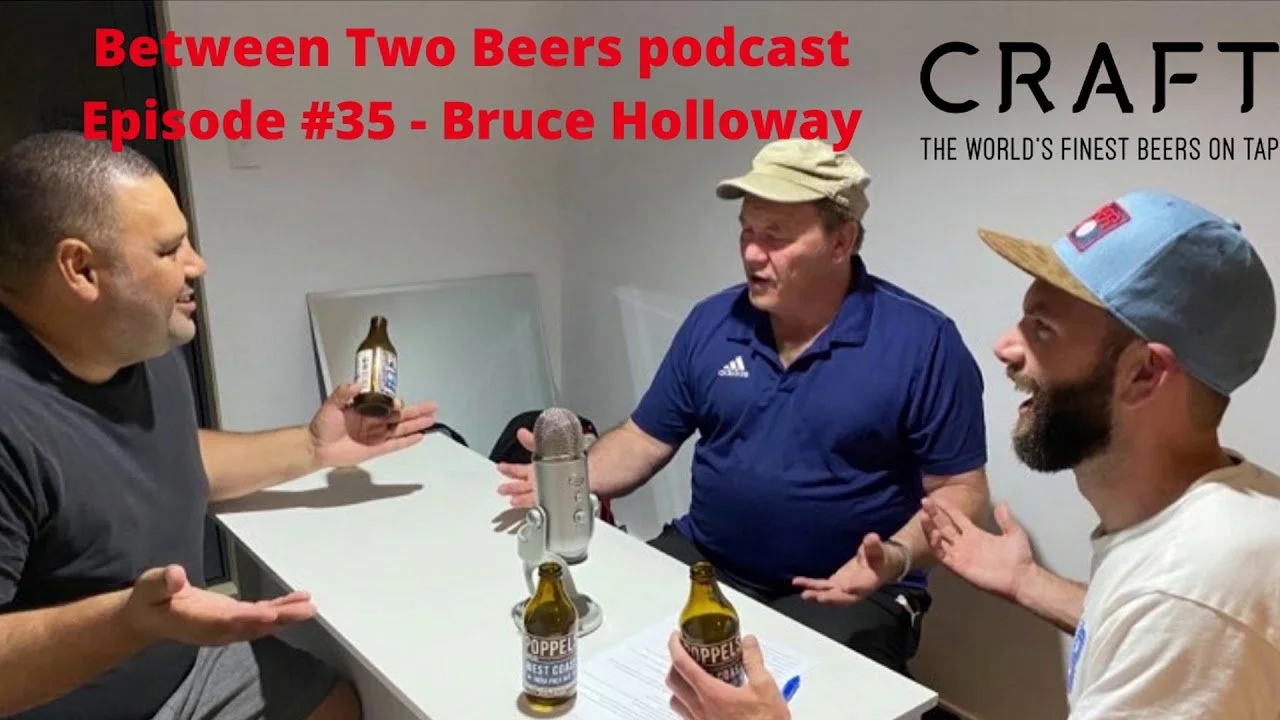
Between Two Beers Podcast in their earlier days.
Q: What were those early days like in terms of audience and feedback?
A: We were total amateurs! We didn’t even have the show on podcast apps at first; we just put it on SoundCloud and Facebook. The first episode got maybe 12 listens, but there was one comment that said, "Enjoyed the chat lads, keep it up," and that was honestly all we needed to keep going.
Our second episode with Paul Nixon was quite memorable and significant. He was my high school football coach at Hamilton Boys High and coached Melville, taking us to the Chatham Cup final. I knew him incredibly well, but there was a significant part of his life we’d never really talked about; his wife had passed away from cancer, and he spoke about his challenges of raising four kids. It made me realise that there are parts of people's lives that you are genuinely curious about, but there is never really the right time or place to bring them up. When you officially invite someone to talk about their life and put a microphone on the table, you essentially get permission to ask whatever you want. We spoke deeply about his loss and his football career, and I found it so compelling that I just wanted to keep going. It proved that we could make real breakthroughs with people, and that realisation is a big reason the show is where it is today.
We did it for four years without making a cent, simply because we enjoyed it and it was our favourite time of the week.
It made me realise that there are parts of people's lives that you are genuinely curious about, but there is never really the right time or place to bring them up. When you officially invite someone to talk about their life and put a microphone on the table, you essentially get permission to ask whatever you want.
Q: What was the moment you realised this could be more than just a hobby in a garage?
A: The podcast had a small following around Hamilton Football circles, but the people who liked it, really liked it and became loyal fans. We had released about 20 episodes of just footballers who were also people we knew. We then thought, “can we do this with people we don’t know?”.
The breakthrough was Eric Murray. We went to his house in Cambridge, took a dozen beers of which he probably drank 10 of them in the first 15 minutes and we got absolute gold out of him! I remember driving back thinking, "If we can do that with one of our greatest Olympians, we can do it with anyone".
Then COVID hit, which was actually great for us. People were trapped at home and were happy to spend 90 minutes chatting on video. We had huge names such as John Kirwan and Laura McGoldrick during that period. Once you have those names, it validates you when you approach the next guest.
Q: Growing the podcast from a hobby in the garage to a professional business is a huge leap. How did you manage the scaling process?
A: We realised we had great content but no way for people to discover us. We reached out to Mike Lane at the ACC (Alternative Commentary Collective), and we joined New Zealand Media and Entertainment (NZME) on a revenue-share deal. It was a financially unfavourable deal for us, but we didn't care because it was about growth. It allowed us to use a professional studio and grow our social channels.
Another important part of scaling our podcast was working with Marcus Logan who runs Via Digital. We were actually his first podcast client, and at the time, he was a one-man operation. Seamus had worked with him previously, so we already had that connection and trust in place. Marcus came to us with a big social media presentation and a very specific strategy: instead of just building one or two channels, we were going to build five at the same time. The idea was to take one piece of content and distribute it across Facebook, Instagram, LinkedIn, TikTok, and YouTube Shorts simultaneously.
While that multi-platform approach might seem obvious now, five years ago, not many people were doing it that aggressively. It was an incredible foundational piece of the business. Today, those channels have grown to between 40,000 and 70,000 followers each and have become a huge part of our actual revenue stream.
While that multi-platform approach might seem obvious now, five years ago, not many people were doing it that aggressively. It was an incredible foundational piece of the business. Today, those channels have grown to between 40,000 and 70,000 followers each and have become a huge part of our actual revenue stream.
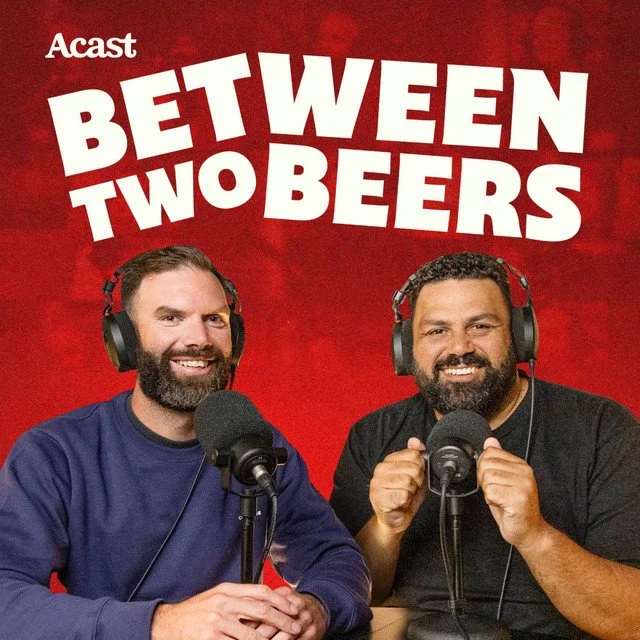
New Zealand’s number one podcast, Between Two Beers podcast with Steve and Seamus.
Q: Tell me about the journey from moving away from NZME and becoming more independent.
A: The biggest turning point was realising we needed to sell the show ourselves. We’d been doing it as a side hustle for three and a half years while I was at the Herald. I saw a path where it could be full-time, but I had to back myself to sell it. I told Shay, "I’m taking the risk. I need to be paid a salary, and you need to work for free until I bring in enough money to pay you full-time". He agreed, and he was full-time within six months.
I saw a path where it could be full-time, but I had to back myself to sell it. I told Shay, "I’m taking the risk. I need to be paid a salary, and you need to work for free until I bring in enough money to pay you full-time". He agreed, and he was full-time within six months.
Q: How hard was it for you to finally pull the trigger and go "all in" on the podcast?
A: Interestingly, it wasn't hard for me. While it might look like a huge jump from the outside where I left a job while having four kids and a significant mortgage, it just made sense at the time. I didn't just walk away blindly; I phased my exit by dropping down to two days a week at the Herald for a few months to ensure I could make money before taking the "training wheels" off entirely.
While it might look like a huge jump from the outside where I left a job while having four kids and a significant mortgage, it just made sense at the time. I didn't just walk away blindly; I phased my exit by dropping down to two days a week at the Herald for a few months to ensure I could make money before taking the "training wheels" off entirely.
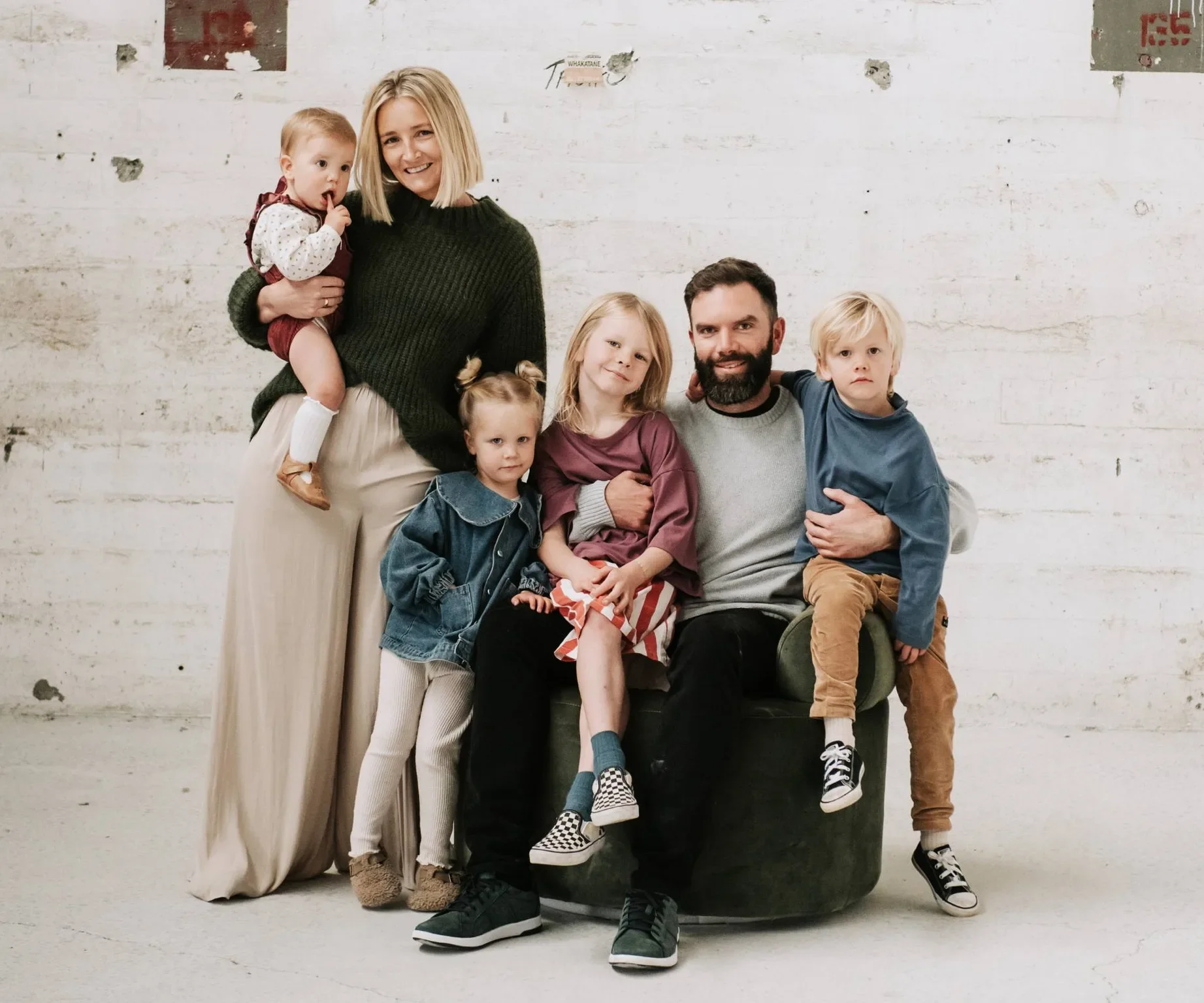
Steve with his family.
Q: How did you know the timing was right and what advice would you give young professionals who are thinking about going all in on their side hustle?
A: I had a conversation with Di Foster, who is our business and mindset coach and co-hosts our Accidental Business Owners show. She asked me how much runway I had. I had eight weeks of leave saved up plus some savings, so about three months of runway in total. She asked, "If it doesn't work, could you find another job in two months?" I said, "100%," and she said, "Then what’s the problem?".
My advice is that you need to see the pathway for your side hustle to become fulltime. I also had a "Plan B" - our Reflections business, where we capture people’s life stories on audio. I knew that if the podcast didn’t work out, I could put all my energy into Reflections and make more money than I did at the Herald.
My advice is that you need to see the pathway for your side hustle to become fulltime.
Q: You often mention that the best thing you’ve done for the business is surrounding yourself with the right people. How did you go about building that support network with people such as Di Foster and Matty Hinton when you were starting from scratch?
A: It’s been absolutely foundational. The best thing we have ever done is surround ourselves with people who are smarter than us. Right from the beginning, Seamus and I were very open and transparent about the fact that we didn’t really know what we were doing. We had a good nose for who the right people were, but we weren't afraid to admit we needed guidance.
For example, I put a lot of value on the recommendations of people I trust. That’s how we found Di, who has been transformative for us. I remember our first two-hour session in Auckland; I went in trying to have all the right answers, but she saw right through it and called "bulls***" on everything. It was exactly what I needed - she gave me a clearer picture of what I had to do and encouraged me to believe in myself more.
The best thing we have ever done is surround ourselves with people who are smarter than us.
Q: I imagine that you’ve had to be quite vulnerable and honest about your shortcomings to get that level of help.
A: 100%. You have to be willing to learn and embrace the fact that others know better than you. I remember meeting with our friend who’s an accountant and Seamus and I literally asked him, "What is GST? Explain it to us like we’re ten". We were basically financially illiterate at the time.
Through the patience of people like Matty and Di, we set up an advisory group that provided us with structure. Those meetings have been challenging and even emotional at times, but they were essential for our growth. Whether it was learning how to write a CEO report or understanding cash flow, I’ve just tried to embrace the attitude of a constant learner.
Whether it was learning how to write a CEO report or understanding cash flow, I’ve just tried to embrace the attitude of a constant learner.
Q: Having sat across from so many top performers, do you think this "people-first" approach is a common thread among the most successful people in New Zealand?
A: Definitely, and in all aspects of life such as sport, business, and the arts. You pick up on these subconscious messages that success is rarely a solo act. I think that’s a byproduct of the podcast - the privilege of sitting in those rooms and picking the brains of the best in the country. It has taught me that you can build something cool, but you must recognise the limits of your own knowledge and seek out the experts who can help you scale it.
It has taught me that you can build something cool, but you must recognise the limits of your own knowledge and seek out the experts who can help you scale it.
Q: You’ve spoken before about wanting to build something more than just a podcast. Why wasn't the success of the show itself enough for you?
A: I’ve learned a lot about myself over the last few years, and I realised I have a drive to build something big that’s not just one thing, but multiple things. Part of that is practical; I have four kids and a massive mortgage, so I need diversity in our revenue streams. I didn't want to put everything on "one horse" because if that one thing fails, it puts the family at risk.
Q: What was it about the podcast model that pushed you toward other ventures like the speaking bureau and the Reflections business?
A: I realised that a podcast, as we’ve built it, relies entirely on Seamus and me being "the talent". In that sense, it’s not a business; it’s a practice. The second we stop turning up, we stop making money. I wanted to protect against that by building entities that weren't solely dependent on my hands-on involvement.
The speaking bureau came from a realisation that we had these unique relationships with New Zealand’s most successful people and it seemed like a natural opportunity to turn those connections into a speaking bureau where we could "clip the ticket" on those relationships.
Reflections started as a "side hustle on a side hustle”, and I realised that there was immense value in capturing people’s life stories. The concept is simple but powerful: we sell "Reflections packages" where we take our audio kit to someone's house and record their entire life history. We eventually partnered with Caley, who is based in London. He had the same energy for the project but more time to build it out.
My naive brain from three years ago thought I could just build these businesses up and then they wouldn’t need me anymore. It’s proven to be a lot harder than I thought, but the goal was always to create challenges for myself while protecting the business from being tied only to our physical presence.
I realised that a podcast, as we’ve built it, relies entirely on Seamus and me being "the talent". In that sense, it’s not a business; it’s a practice. The second we stop turning up, we stop making money. I wanted to protect against that by building entities that weren't solely dependent on my hands-on involvement.
Q: What have you learned about the challenge of diversifying your interests while trying to maintain the quality of your core product?
A: We definitely learned the hard way about spreading ourselves thin. There was a period in the middle of last year where it all got to be too much; I had lost my focus and intention with my time because we were saying "yes" to every opportunity that came our way. I actually had a bit of a breakdown as a result of trying to run the podcast, the speaking business, and Reflections all at once.
Q: How did you find your way back to that core focus?
A: It came down to a very challenging advisory meeting with Matty and Di where we decided to strip everything back. We realised that the podcast, which comprises of Between Two Beers, Hambassadors, and Accidental Business Owners is our engine. If we make those the best shows in New Zealand and put our time into making them world-class, the rest will take care of itself. We had to learn to "keep feeding that beast" rather than getting distracted.
Q: What does that balance look like for the business now?
A: We’ve become much more selective. We realised that if we couldn't give a project the time it needed to succeed, it wasn't worth doing. That’s why we had a "conscious uncoupling" with the speaking bureau to focus on what was already flying. Now, the focus is 100% on the podcast and growing the Reflections business as the secondary "horse" we want to back. By clearing away the distractions and focusing on our core shows and sales, we totally transformed the business in the second half of last year.
We’ve become much more selective. We realised that if we couldn't give a project the time it needed to succeed, it wasn't worth doing.

Steve’s Reflections business.
Q: As both the CEO and "the talent", how do you balance the need to work in the business with the necessity of working on the business?
A: That is probably the question I’ve struggled to unpack the most, and it is incredibly hard. For anyone building their own business, there is a stage where you must fight through a specific barrier: if you aren't the one doing the work, it simply won't get done. However, to reach a point where you can hire someone else to do it, you have to make more money, which usually requires you to keep doing that work yourself.
Last year was particularly taxing because I was wearing both hats. We were releasing eight podcasts a month while I was simultaneously driving the business strategy, handling all the sales, and managing the reporting for our accounts. You essentially just have to do it all until you reach a point where you don't have to anymore. We have actually just pushed through that period by hiring our first full-time employee to handle commercial partnerships and the general "running of the ship" so Seamus and I can focus on where our time is best spent.
For anyone building their own business, there is a stage where you must fight through a specific barrier: if you aren't the one doing the work, it simply won't get done. However, to reach a point where you can hire someone else to do it, you have to make more money, which usually requires you to keep doing that work yourself.
Q: You’ve mentioned attending The Icehouse Owner Management Programme to help with this transition. What did that teach you about shifting your focus?
A: The course focused heavily on exactly that - how to work on the business instead of in it. In the early stages of that five-month program, I was still firing out emails from 5:00 AM to 8:00 AM before the course even started, and then doing the same late into the night.
A real sign of my growth was that by the later blocks of the course, I wasn't doing that anymore. I had finally implemented enough structure, process, and delegation to find my way. My natural style tends to be quite chaotic, so I’ve had to consciously learn to become more structured and process-oriented to ensure the business can function without me being involved in every single task.
My natural style tends to be quite chaotic, so I’ve had to consciously learn to become more structured and process-oriented to ensure the business can function without me being involved in every single task.
Q: How do you find the balance between work and family?
A: It’s a constant struggle, but "Phoneless Saturdays" have been life changing. I turn my phone off on Friday night and don't turn it on until Sunday. Being uncontactable is incredibly freeing. I have four kids at ages where they just want to spend time with me, so although I’m working or away Monday to Friday, nothing should trump them on a Saturday.
I also have pillars that keep me grounded such as cold showers for the last five years, fasting until the family dinner at 5:00 PM, and getting up early to have time for myself. I also do my best thinking while swimming; it lets the brain go "free and wild".
"Phoneless Saturdays" have been life changing. I turn my phone off on Friday night and don't turn it on until Sunday. Being uncontactable is incredibly freeing. I have four kids at ages where they just want to spend time with me, so although I’m working or away Monday to Friday, nothing should trump them on a Saturday.
Q: After interviewing so many successful people, what are the common traits you see in high performers?
A: They all work so much harder than you think. Whether it’s Lisa Carrington or Geoff Ross, they consistently show up when others wouldn't. They are also exceptional communicators, and I don't mean just talking; I mean listening and making others feel empowered.
Whether it’s Lisa Carrington or Geoff Ross, they consistently show up when others wouldn't. They are also exceptional communicators, and I don't mean just talking; I mean listening and making others feel empowered.
But the biggest one is authenticity. You can see through it immediately if someone isn't being legit. When someone like Mark Stafford or Liam Messam is fully themselves and comfortable being vulnerable, it’s contagious. Liam was so humble it was almost unnatural for him to talk about himself, but that’s what makes him such an incredible leader - everything he says is real.
You can see through it immediately if someone isn't being legit. When someone like Mark Stafford or Liam Messam is fully themselves and comfortable being vulnerable, it’s contagious.
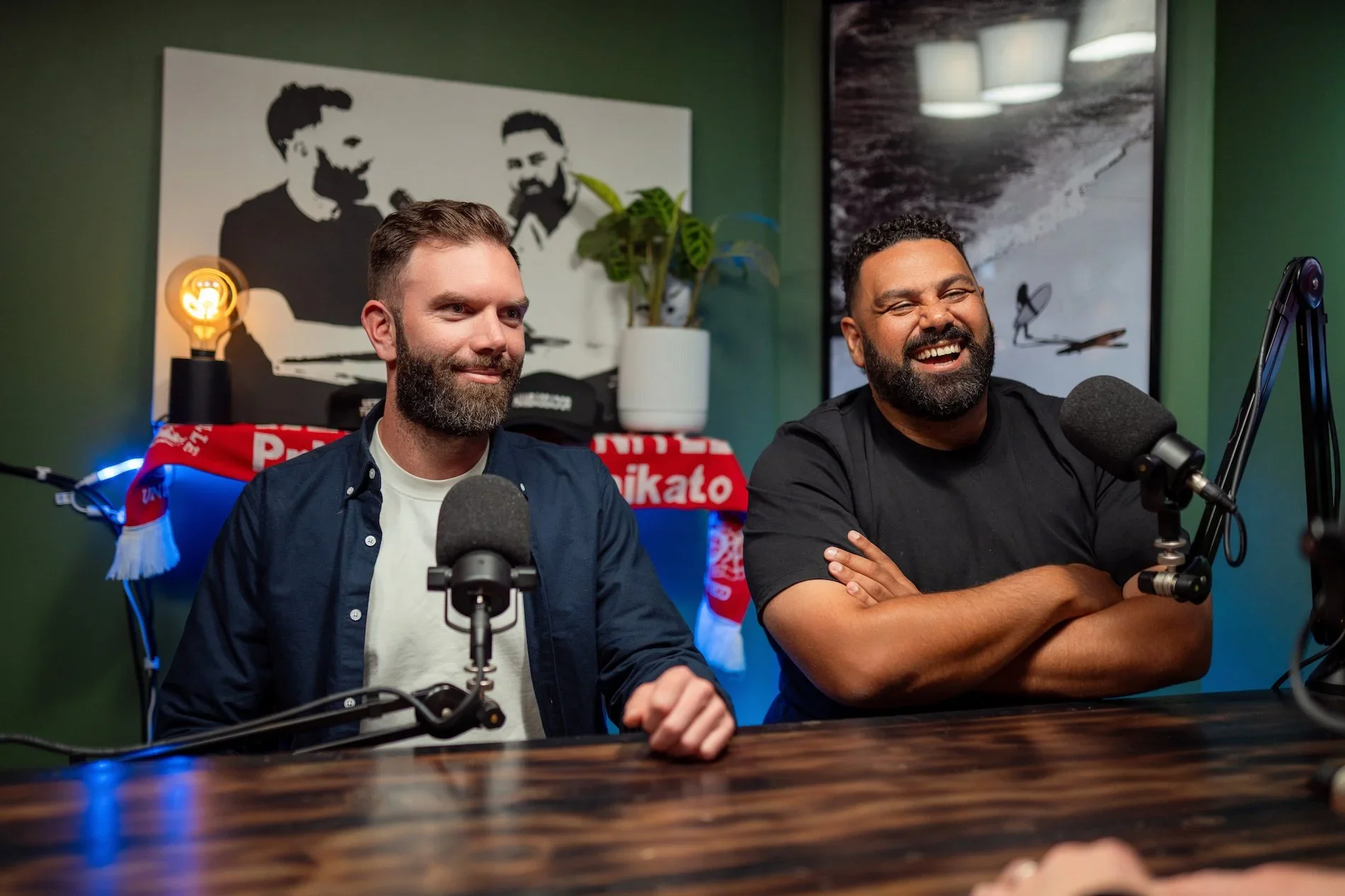
New Zealand’s number one podcast, Between Two Beers podcast with Steve and Seamus in action.
Q: What does Steve Holloway stand for?
A: That’s a great question, and to be honest, I realised recently that I didn’t have a thorough answer for it. We had a guest on the show named Carl Sheridan who helps people find their "why" and understand what they stand for. While he was here, I realised there was a gap in my own story, and I wanted to lean into it.
I’m about to spend a half-day with Carl to put some concentrated time into figuring that out. If I had to answer today, I’d say I stand for family, which is the most important thing, fun, and building cool stuff, but I know there’s got to be more to it than that.
Q: A popular topic for many young professionals is the OE (Overseas Experience). Having lived in the U.S. for four years, what is your advice to those who are on the thinking about going?
A: I’d say go. I believe your 20s should be about experiences, taking big swings, and seeing the world. There will eventually be a time in your life when you are buckled down with responsibilities, mortgages, and children, and you won’t have that same level of freedom. My time in America definitely shaped who I am, and I would do it all exactly the same way again. My advice is to spread your wings and see as much of the world as possible so that you have a massive frame of reference for when you do finally decide to settle down somewhere.
My advice is to spread your wings and see as much of the world as possible so that you have a massive frame of reference for when you do finally decide to settle down somewhere.
Q: Many of our readers are young professionals who are beginning to think about their financial futures. Do you have any general advice or wisdom you could offer them?
A: I’ll be honest, I’m actually probably a really bad person to ask about this because I’ve never been particularly financially responsible in the traditional sense. My own path involved living with my parents and then finding a way to make money through poker, which was high-risk and high-variance; I probably wouldn’t recommend that specific route to most people.
However, my best advice is to cut the strings to your parents, step out on your own, and start problem-solving. If you have a problem, you have to be the one to figure it out. You need to find what you are best at and find a way to make money from it. If you have the drive and determination and are willing to put in the time and effort, you will succeed. I worked at the Herald for 12 years and never even knew I was a good interviewer until we started the podcast, and I committed to getting better at it. My philosophy is simple: find something you enjoy doing enough that you’d do it for free and then find a way to make money from it.
I worked at the Herald for 12 years and never even knew I was a good interviewer until we started the podcast, and I committed to getting better at it. My philosophy is simple: find something you enjoy doing enough that you’d do it for free and then find a way to make money from it.
Q: What advice would you give to your younger self?
A: Stretch every day, because your body will eventually pack up on you!
More seriously, your 20s are for taking in as many experiences as possible. It’s a tricky, messy time for everyone, and you won't have all the answers. If things get choppy, just stick with it and be kind to yourself.
More seriously, your 20s are for taking in as many experiences as possible. It’s a tricky, messy time for everyone, and you won't have all the answers. If things get choppy, just stick with it and be kind to yourself.
Q: Finally, if neither time nor resources were a constraint, what ultimate goal or dream would you pursue or have pursued?
A: Honestly, I feel like I have a dream job. I love coming into work, I have incredible conversations with my best mate, and I live three minutes away from work. I’d just want more of the same, but maybe a bit more time with the kids while they’re young, and I’d definitely like to get my golf handicap down to scratch! Other than that, I’m just happy to keep building and growing.
About Between Two Beers
Between Two Beers is New Zealand’s top long‑form interview podcast. Each episode features candid, thoughtful conversations with notable Kiwis from sport, business, media and the arts that unpacks life lessons, career pivots and behind‑the‑scenes stories with warmth, curiosity and good humour.
Visit the website here: https://www.betweentwobeerspodcast.com/
About Reflections
Reflections is a New Zealand‑based team creating private family documentaries that preserve the stories, wisdom and memories of everyday Kiwi families. Founded by storytellers Steve Holloway, Seamus Marten and Caley Wilson, with executive Kerry Quin, the award‑winning team blends interviewing craft from journalism, podcasting and broadcasting to capture thoughtful long‑form conversations and build lasting legacies.
Visit the website here: https://www.reflections.life/team
About New Zealand Herald
The New Zealand Herald is Aotearoa New Zealand’s leading daily news brand, published by NZME and based in Tāmaki Makaurau/Auckland. Across print, nzherald.co.nz, its app, newsletters and podcasts, it delivers national and Auckland news, business, politics, sport, culture and opinion, alongside investigative reporting and analysis.
Visit the website here: https://www.nzherald.co.nz/
About Waikato Times
The Waikato Times is a leading regional newspaper serving Kirikiriroa Hamilton and the wider Waikato. Published by Stuff, it delivers trusted local reporting across print, e‑Edition and Stuff.co.nz, covering community issues, business, sport, rural affairs, culture and opinion with a strong focus on the stories that matter to Waikato communities.
Visit the website here: https://www.waikatotimes.co.nz/
About Monmouth University
Monmouth University is a student‑centred university on the New Jersey shore (West Long Branch), offering a broad range of undergraduate and postgraduate programmes across the arts, sciences, business, education and health. With a focus on applied learning, research and community engagement, it pairs a coastal campus setting with strong industry and civic partnerships.
Visit the website here: https://www.monmouth.edu/
